If you spend time on social media, texting apps, online gaming platforms, or dating apps, you have probably come across the abbreviation “WSG.” Internet slang evolves rapidly, and many people search for unfamiliar terms to understand conversations better and avoid misunderstandings.
Among the many acronyms used in digital communication, WSG has become increasingly popular, especially among younger users.
The phrase is commonly used in casual chats, direct messages, and social networking platforms. While its meaning is generally straightforward, the context in which it appears can slightly change how it is interpreted. Understanding internet slang like WSG can help users communicate more naturally and confidently in online environments.
This guide explains the meaning of WSG, its origins, how people use it in different situations, common misconceptions, alternative expressions, and whether it is appropriate for professional communication. By the end, you’ll know exactly what WSG means and how to respond when someone sends it to you.
Definition & Meaning
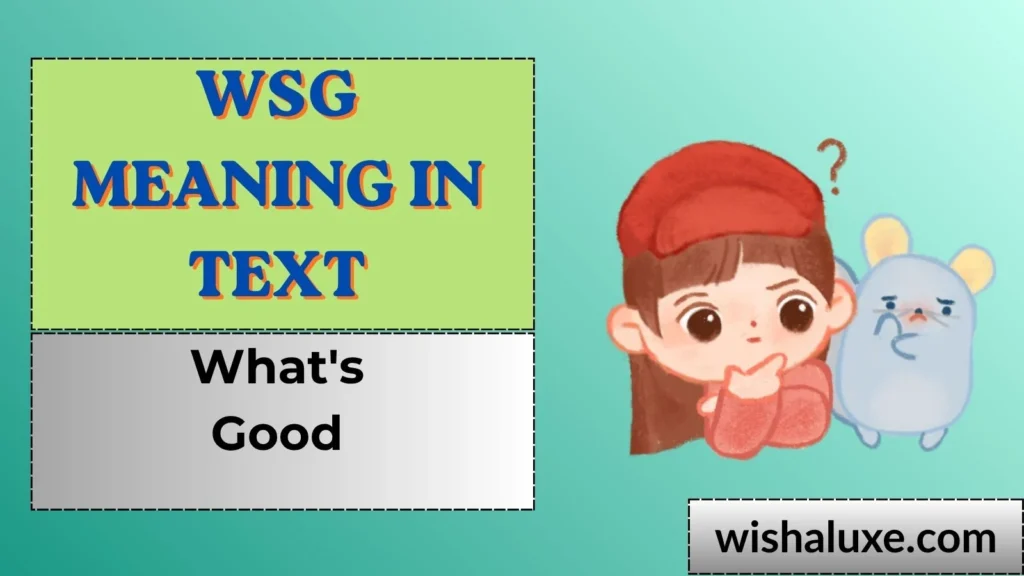
WSG is a shorthand abbreviation that typically stands for “What’s Good?”
The phrase is an informal greeting commonly used in text messages, social media conversations, and online communities. It serves a similar purpose to asking:
- What’s up?
- How are you?
- What’s going on?
- How have you been?
Rather than seeking detailed information, WSG is usually a casual way to start a conversation. The sender is often checking in, saying hello, or inviting interaction.
For example:
- Person A: “WSG?”
- Person B: “Not much, just relaxing. You?”
In most situations, the expression is friendly and conversational. It helps create a relaxed atmosphere and is particularly common among younger internet users.
Because texting favors speed and convenience, abbreviations like WSG allow people to communicate quickly while maintaining a casual tone.
Background & History
Like many internet abbreviations, WSG emerged from the growing culture of digital communication. As texting became more popular, users began shortening frequently used phrases to save time and effort.
The expression “What’s Good?” existed in spoken language long before it appeared online. It was commonly used as a greeting in various communities, particularly in urban slang and youth culture. Over time, people abbreviated the phrase to WSG when communicating through text messages and social media.
The rise of platforms such as Instagram, Snapchat, TikTok, and online gaming communities accelerated its popularity. Younger generations adopted the acronym because it was concise, recognizable, and easy to type.
Today, WSG is widely understood across many online spaces and has become a standard part of modern internet slang. Although its popularity varies by platform and age group, it remains a common greeting in digital conversations.
Usage in Various Contexts
WSG can appear in many different situations depending on the relationship between the people communicating.
Casual Friendships
Friends often use it as a quick greeting.
Example:
- “WSG bro?”
- “Nothing much, just watching a movie.”
Social Media Messages
People frequently send WSG in direct messages when initiating contact.
Example:
- “Hey, WSG?”
- “Just scrolling through posts.”
Gaming Communities
Gamers may use it to check what teammates are doing.
Example:
- “WSG tonight?”
- “Ready for a few matches.”
Dating Conversations
On dating apps, WSG often acts as a conversation starter.
Example:
- “WSG?”
- “Just finished work. How about you?”
Group Chats
The abbreviation may also be used to engage multiple people at once.
Example:
- “WSG everyone?”
- “We’re planning dinner later.”
In nearly every context, the goal is to open communication rather than request specific information.
Common Misconceptions & Clarifications
Many people misunderstand WSG when they first encounter it.
One common misconception is that it always asks for detailed updates. In reality, it often functions simply as a greeting.
Another misunderstanding is that WSG has a hidden meaning in every situation. Most of the time, it literally means “What’s Good?” and nothing more.
Some users assume it is rude because it lacks punctuation or complete words. However, internet slang often prioritizes brevity over formal grammar.
Others confuse WSG with similar abbreviations that have entirely different meanings. Context is important when interpreting online language.
Generally speaking, if someone sends WSG, they are simply trying to start a friendly conversation.
Similar Terms & Alternatives
Several expressions serve the same purpose as WSG.
Popular alternatives include:
- What’s up?
- Sup?
- WYD (What You Doing?)
- How’s it going?
- What’s happening?
- What’s new?
- Yo
- Hey
- How are things?
- What’s going on?
Each variation carries a slightly different tone.
For example, “What’s up?” is universally understood, while WSG may feel more modern and informal. Choosing the right expression often depends on your audience and communication style.
How to Respond to This Term
Responding to WSG is simple because it functions like a casual greeting.
Possible responses include:
- “Nothing much, you?”
- “Just chilling.”
- “Doing great. What’s up?”
- “Working right now.”
- “Not much going on.”
- “All good here.”
You can also use the opportunity to continue the conversation.
Examples:
- “Not much. What are you up to?”
- Just got home. How’s your day?”
- “Pretty busy today. What about you?”
A relaxed response is usually the best approach.
Regional or Cultural Differences
The use of WSG varies across different regions and communities.
In some English-speaking areas, the phrase “What’s Good?” has been part of everyday speech for years. In others, it became popular primarily through internet culture.
Younger users are generally more familiar with the abbreviation than older generations. Social media trends also influence how frequently it appears in different countries.
Some communities use WSG almost exclusively as a greeting, while others may use it to ask what someone is doing or planning.
Despite these variations, the overall meaning remains largely consistent across regions.
Comparison with Similar Terms
Although WSG shares similarities with other internet abbreviations, there are subtle differences.
| Term | Meaning | Typical Usage |
|---|---|---|
| WSG | What’s Good? | Casual greeting |
| WYD | What You Doing? | Asking about current activity |
| WSP | What’s Up? | General greeting |
| SUP | What’s Up? | Informal greeting |
| HBU | How About You? | Follow-up question |
| HMU | Hit Me Up | Invitation to contact |
WSG is typically broader and more conversational than WYD, which specifically asks what someone is doing.
Usage in Online Communities & Dating Apps
Online communities have played a major role in popularizing WSG.
On social media, users often send it as a low-pressure conversation starter. Unlike lengthy introductions, WSG feels casual and approachable.
In gaming communities, it can serve as a quick check-in before playing.
On dating apps, WSG is frequently used to break the ice. Instead of crafting a long opening message, many users send a simple WSG to gauge interest.
However, some people may view extremely short greetings as less engaging. Adding a personal question often creates better conversations.
For example:
- “WSG? How’s your week been?”
- “WSG? Doing anything fun today?”
These messages tend to encourage more meaningful responses.
Hidden or Offensive Meanings
In most situations, WSG is harmless and non-offensive.
However, internet slang can occasionally develop alternative meanings within specific groups or communities. These alternative interpretations are typically uncommon and heavily dependent on context.
For the vast majority of users, WSG simply means “What’s Good?” and carries no offensive intent.
If a conversation seems unclear, reviewing surrounding messages can help determine the intended meaning.
Generally, there is no reason to assume negative or inappropriate implications when encountering WSG.
Suitability for Professional Communication
WSG is best reserved for informal communication.
In professional settings, formal greetings are usually more appropriate.
Examples of professional alternatives include:
- Hello
- Good morning
- Good afternoon
- How are you?
- I hope you’re doing well
Using WSG in workplace emails, business reports, or official correspondence may appear overly casual.
However, it may be acceptable among coworkers who already communicate informally through messaging platforms.
When in doubt, choose a more professional greeting.
Evolution of WSG in Digital Slang Culture
WSG has evolved alongside the rapid growth of internet slang. Early online communication relied on full phrases, but as texting became dominant, users started shortening everyday expressions. WSG became part of this shift, reflecting how language adapts to speed and convenience.
Over time, it moved from niche usage in urban slang communities to mainstream digital communication. Today, it is widely recognized across platforms like Instagram, Snapchat, and TikTok. Its evolution shows how informal language spreads quickly through memes, influencers, and peer-to-peer messaging.
Psychological Appeal Behind Using WSG
One reason WSG is so widely used is its psychological simplicity. Short greetings reduce social pressure and make conversations feel easier to start. Instead of crafting a full sentence, users can send a quick “WSG?” to open interaction without overthinking.
It also creates a sense of familiarity and friendliness. Because it feels casual, it lowers barriers in communication and encourages faster responses. This makes it especially popular among people who prefer low-effort social engagement in digital spaces.
Role of WSG in Meme Culture and Internet Humor
WSG is not just a greeting—it also appears in meme culture. Many memes use it humorously to represent casual or lazy communication styles. For example, exaggerated versions like “WSG at 3AM?” or “WSG fr fr” are often used for comedic effect.
Memes help spread slang faster, especially among younger audiences. When users see WSG in humorous content, they are more likely to adopt it in real conversations. This blend of humor and communication has made WSG a recognizable part of internet identity.
Variations of WSG Used in Different Communities
Different online groups modify WSG to fit their style of communication. Some common variations include:
- “WSG bro?” – Friendly masculine tone
- “WSG bae?” – Used in romantic contexts
- “WSG fam?” – Used among close friends or communities
- “WSG rn?” – Asking what someone is doing right now
These variations show how flexible the term is. Users often personalize it based on tone, relationship, and platform culture.
Influence of Social Media Platforms on WSG Popularity
Social media platforms play a major role in spreading WSG. On apps like TikTok and Instagram, short captions and comments encourage the use of abbreviations. Influencers and creators often use WSG in captions or direct messages, making it more visible to large audiences.
The algorithm-driven nature of these platforms also helps slang go viral quickly. Once a term like WSG starts trending, it spreads rapidly through comments, reposts, and short-form videos.
Linguistic Breakdown of the Term WSG
From a linguistic perspective, WSG is an acronym formed from a question phrase. It demonstrates how English grammar can be compressed without losing core meaning.
- “What’s” is shortened from “What is”
- “Good” remains unchanged but becomes context-dependent
This type of abbreviation reflects a broader trend in digital linguistics, where efficiency often overrides grammatical completeness. It also shows how spoken language influences written online communication.
Impact of WSG on Modern Communication Style
WSG contributes to a broader shift toward minimalistic communication. Instead of long introductions, users now prefer short, direct expressions that still carry social meaning.
This change affects not only casual chats but also how people perceive tone and personality online. Short phrases like WSG make communication feel faster but sometimes less expressive, depending on context.
Misinterpretation Risks When Using WSG
Although WSG is simple, it can sometimes lead to misunderstandings. Some users may interpret it as too vague or impersonal, especially in professional or formal settings.
In certain conversations, lack of context can make it unclear whether the sender is greeting, asking a question, or simply checking in. This is why adding follow-up context is often important.
Example:
- Better: “WSG? What are you up to today?”
- Too vague: “WSG?”
WSG in Cross-Generational Communication
Younger users tend to understand WSG instantly, while older generations may find it confusing or unfamiliar. This creates a slight communication gap between age groups in digital conversations.
Teenagers and young adults often use it naturally, while older users may prefer full phrases like “What’s up?” or “How are you?” This difference highlights how internet slang evolves within specific age-based communities.
Emotional Tone and Intent Behind WSG
The emotional tone of WSG depends heavily on context. It can feel:
- Friendly when used between friends
- Curious when asking about someone’s activity
- Flirty in dating conversations
- Neutral when used as a simple check-in
Because it lacks punctuation and structure, tone is interpreted based on relationship and message flow rather than grammar.
Role of WSG in Fast-Paced Digital Communication
In today’s fast-moving digital world, attention spans are shorter, and conversations happen quickly. WSG fits perfectly into this environment because it allows users to initiate interaction instantly.
FAQs:
What does WSG stand for in texting?
WSG usually stands for “What’s Good?” and is commonly used as a casual greeting.
Is WSG the same as What’s Up?
They are very similar. Both are informal greetings used to start conversations.
Can WSG be used on dating apps?
Yes. Many users send WSG as an icebreaker when starting a conversation.
Is WSG considered rude?
No. It is generally viewed as friendly and informal rather than rude.
How should I reply to WSG?
You can respond with updates about what you’re doing or simply ask the other person how they are.
Is WSG appropriate for work emails?
Usually not. Professional greetings are more suitable in workplace communication.
Conclusion:
WSG is a popular internet abbreviation that stands for “What’s Good?” and is primarily used as a casual greeting in text messages, social media conversations, gaming communities, and dating apps. Its purpose is to start friendly interactions rather than request detailed information.
Although it shares similarities with phrases like “What’s Up?” and “How’s it going?”, it has developed its own place within modern digital communication. Understanding how and when to use WSG can help you communicate more naturally online, avoid confusion, and respond confidently when encountering contemporary internet slang.

Hi, I’m Alex Carry, the creator of Wishaluxe. I’m passionate about helping people find the perfect words for every special occasion, from birthdays and anniversaries to celebrations and heartfelt moments. Through Wishaluxe, I share creative ideas, meaningful messages, and inspiring content designed to make every occasion more memorable. My goal is simple: to help readers express their feelings with confidence and create lasting connections through thoughtful words.