If you’ve ever received a message containing only hm from a girl, you may have wondered what she actually meant. Unlike many internet abbreviations that have a fixed definition, “hm” can carry different meanings depending on the conversation, tone, and relationship between the people chatting.
This simple expression is commonly used in text messages, social media conversations, online forums, and dating apps.
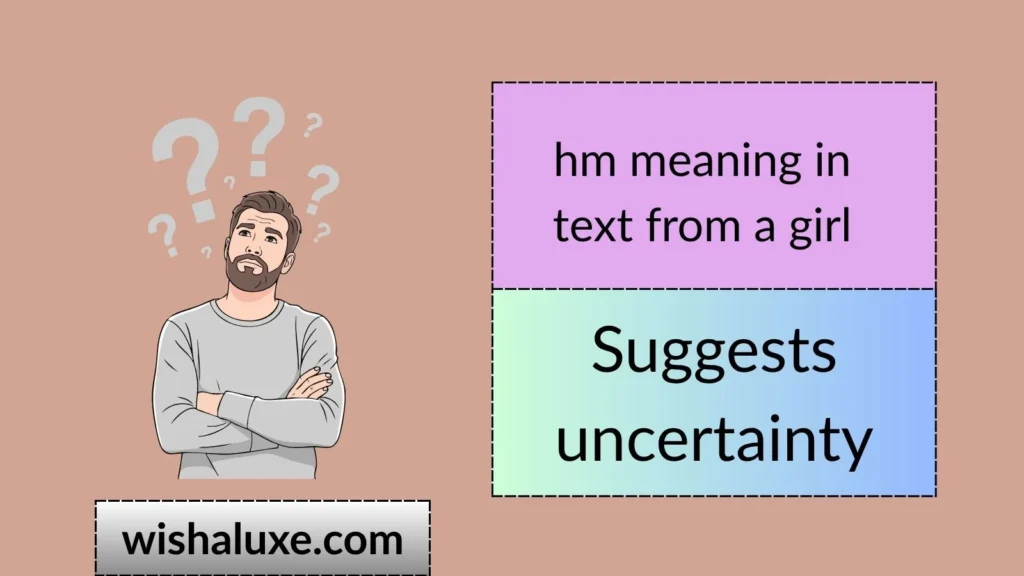
People often search for the meaning of this term because it can be confusing. Sometimes it signals interest and thoughtfulness, while in other situations it may indicate uncertainty, boredom, disagreement, or even mild frustration.
Understanding the context behind the message is important before jumping to conclusions.
In modern digital communication, short responses often carry emotional clues that are not immediately obvious. Learning how to interpret hm correctly can help prevent misunderstandings and improve online conversations.
This guide explains its meaning, history, common uses, alternatives, and the best ways to respond when a girl sends hm in a text.
Definition & Meaning
The expression “hm” is a written version of a thoughtful sound people make during conversations. It usually represents someone pausing to think, consider information, or react to something they have heard or read.
When used in a text message from a girl, it may have several meanings:
- She is thinking about what to say next.
- She is unsure about a topic.
- She is processing information.
- She may not fully agree with something.
- She wants more details before responding.
- She is expressing curiosity.
Unlike direct words such as “yes” or “no,” “hm” leaves room for interpretation. The exact meaning often depends on the surrounding messages.
For example:
- “Hm, that’s interesting.” — Shows curiosity.
- “Hm…” — Suggests uncertainty or hesitation.
- “Hm okay.” — Can indicate acceptance or mild disagreement.
The number of letters and punctuation marks can also influence the tone. A short “hm” may feel neutral, while “hmmm” often suggests deeper thought or skepticism.
Background & History
The sound represented by “hm” has existed in spoken language for centuries. People naturally make sounds like “hmm,” “uh-huh,” and “ah” when processing information or expressing emotions without using complete sentences.
As texting became popular in the late 1990s and early 2000s, users began writing these sounds in digital conversations. Since typing was often done on small mobile keyboards, short expressions became common.
Over time, “hm” evolved into a versatile text response. It moved from simple acknowledgment to a subtle communication tool that could convey emotions, reactions, and opinions without requiring lengthy explanations.
Social media platforms accelerated its popularity. Users frequently included “hm” in comments, private messages, and chat conversations. Because digital communication lacks facial expressions and vocal tone, people started using slight variations such as:
- Hm
- Hmm
- Hmmm
- Hmmmm
Each variation may communicate a different level of thoughtfulness, doubt, or curiosity.
Today, the expression is recognized globally and appears across messaging apps, social networks, online communities, and dating platforms.
Usage in Various Contexts
The meaning can change dramatically depending on the conversation.
Casual Conversations
Friends often use “hm” when considering an idea or responding casually.
Example:
Person A: “Want to watch a movie tonight?”
Person B: “Hm, maybe.”
Decision-Making
A girl might send “hm” while weighing different options.
Example:
“HM, I’ll think about it.”
Disagreement
Sometimes it serves as a polite way to show doubt.
Example:
“Hm, I’m not sure that’s correct.”
Curiosity
The response may indicate interest and encourage further explanation.
Example:
“Hm, tell me more.”
Emotional Reactions
Depending on context, it can communicate surprise, confusion, or concern.
Example:
“Hm, that’s unexpected.”
Online Discussions
In forums and comment sections, users often employ it to express skepticism or contemplation without making a lengthy argument.
Because context is everything, looking at the surrounding messages is the best way to understand the intended meaning.
Common Misconceptions & Clarifications
Many people misunderstand this expression and assume it always means something negative. In reality, that is not true.
Misconception 1: It Means She’s Angry
A simple “hm” does not automatically indicate anger. It often means she is thinking or processing information.
Misconception 2: She Is Not Interested
Interest levels cannot be determined from one short response alone. The overall conversation matters much more.
Misconception 3: It Always Signals Boredom
While boredom is possible, many people use “hm” simply as a thoughtful response.
Misconception 4: There Is Only One Meaning
The expression is highly flexible and changes depending on context, tone, and relationship dynamics.
Misconception 5: Longer Versions Mean the Same Thing
“Hm” and “hmmm” can feel very different. Longer versions often suggest deeper thinking or stronger uncertainty.
Similar Terms & Alternatives
Several expressions are used similarly in online conversations.
- Hmm
- Hmmm
- Uh-huh
- Oh
- Interesting
- Maybe
- Let me think
- I see
- Okay
- Well
Each alternative carries slightly different emotional nuances. Some indicate agreement, while others express curiosity or hesitation.
People choose among these options based on personality, culture, and communication style.
How to Respond to This Term
The best response depends on the situation.
If She Seems Curious
Provide more information.
Example:
“What part would you like to know more about?”
If She Seems Unsure
Help clarify the topic.
Example:
“I can explain it differently if you’d like.”
If She Appears Hesitant
Give her time to think.
Example:
“No rush. Let me know what you decide.”
If You Are Unsure
Politely ask what she means.
Example:
“What are your thoughts?”
Avoid overanalyzing a single message. Looking at the entire conversation usually provides better insight.
Regional or Cultural Differences
Communication styles vary across countries and cultures.
In some regions, brief responses are considered normal and polite. In others, they may seem distant or uninterested.
Younger generations tend to use short text expressions more frequently than older users. Social media culture has also influenced how people interpret conversational sounds like “hm.”
Language background can play a role as well. Non-native English speakers sometimes use “hm” differently than native speakers, often treating it as a universal sign of thinking or consideration.
Understanding cultural communication habits can prevent unnecessary misunderstandings.
Comparison with Similar Terms
| Term | Common Meaning | Typical Tone |
|---|---|---|
| Hm | Thinking or considering | Neutral |
| Hmm | More thoughtful | Reflective |
| Hmmm | Doubtful or curious | Skeptical |
| Oh | Realization | Surprised |
| Okay | Acceptance | Neutral |
| Maybe | Uncertainty | Indecisive |
| Interesting | Curiosity | Positive |
Although these terms overlap, each creates a slightly different impression in a conversation.
Usage in Online Communities & Dating Apps
On social platforms and dating apps, short responses often carry additional social meaning.
A girl may use “hm” to:
- Show curiosity.
- Evaluate a statement.
- Encourage more conversation.
- Express uncertainty.
- Test conversational flow.
In dating contexts, one message alone rarely reveals strong feelings. Consistent patterns matter more than isolated responses.
For example, if she frequently asks questions after saying “hm,” she is likely engaged in the conversation. If responses become increasingly shorter without follow-up, she may be losing interest.
Always focus on overall communication patterns rather than one word.
Hidden or Offensive Meanings
Generally, “hm” is not considered offensive.
However, tone can sometimes make it seem dismissive or passive-aggressive. For example, a very short response after a long explanation might appear uninterested.
Even then, the interpretation depends heavily on context.
There are no widely recognized offensive definitions associated with the expression itself. Most uses remain neutral and conversational.
Suitability for Professional Communication
Professional settings usually benefit from clear communication.
While “hm” may occasionally appear in workplace chats, it is generally better to use complete responses such as:
- “I understand.”
- “Let me review that.”
- “I need more information.”
- “I’ll consider this.”
These alternatives reduce ambiguity and create a more professional impression.
Informal shorthand is better suited to casual conversations among friends, family members, and social contacts.
Why Girls Often Use Short Text Responses
Many girls prefer brief responses during online conversations because they are quick, convenient, and easy to send. A short reply does not automatically mean disinterest. In many cases, it simply reflects a person’s texting style.
Some people enjoy long conversations, while others communicate efficiently with fewer words. Understanding individual communication habits is important before making assumptions about the meaning behind a message.
Emotional Clues Hidden Behind Simple Replies
Even a small response can reveal emotions when viewed within the larger conversation. Depending on timing and context, it may suggest curiosity, confusion, excitement, disappointment, or hesitation.
Looking at previous messages and the overall tone can provide valuable clues about what the sender is feeling.
When the Response Shows Genuine Interest
Sometimes a thoughtful reply indicates that the person is carefully considering what was said. Rather than rushing to answer, they may be taking time to process information.
This can be a positive sign, especially when followed by questions, comments, or continued engagement in the conversation.
Signs the Conversation May Need More Effort
Occasionally, a minimal response can signal that the discussion has lost momentum. If messages become increasingly shorter without follow up questions or enthusiasm, it may be helpful to introduce a new topic, ask an open ended question, or make the conversation more engaging.
The Role of Tone in Digital Communication
Text messages lack facial expressions, body language, and vocal cues. Because of this, the same word can have multiple interpretations. A response that seems cold in one situation may appear thoughtful or friendly in another.
Understanding tone requires considering the entire conversation rather than focusing on a single message.
How Age Groups Interpret Texting Expressions
Different generations often interpret online language differently. Younger users who grew up with texting and social media may view short replies as completely normal. Older generations sometimes expect more detailed responses.
These differences can occasionally create misunderstandings between people from different age groups.
Why Overthinking Messages Can Be Misleading
Many people spend too much time analyzing short texts and searching for hidden meanings. While context matters, not every message contains a secret message.
Sometimes the simplest explanation is the correct one: the sender is merely thinking, busy, distracted, or responding casually.
The Impact of Conversation Timing
The timing of a reply can influence how it is perceived. A thoughtful response sent immediately after a question may indicate active engagement. The same response sent hours later could be interpreted differently.
However, timing alone should never be used to judge someone’s feelings or intentions.
How Social Media Has Changed Texting Language
Modern platforms encourage fast communication, leading users to create shorter expressions and reactions. As social media continues to evolve, brief responses have become a normal part of digital interaction.
Many expressions that once seemed unusual are now widely accepted across multiple platforms.
Understanding Passive and Active Engagement
Active engagement includes asking questions, sharing opinions, and contributing to the conversation. Passive engagement often involves shorter reactions or acknowledgments.
Neither style is inherently negative, but recognizing the difference can help you understand the direction of a conversation.
Situations Where Clarification Is Helpful
If a response seems unclear or confusing, asking a polite follow-up question is often the best approach.
Instead of making assumptions, seeking clarification can prevent misunderstandings and keep the conversation moving naturally.
The Psychology Behind Thoughtful Pauses
People frequently pause before responding when they are processing information, evaluating choices, or considering emotions. In digital communication, these pauses are often represented through brief text expressions.
This behavior reflects normal human thinking rather than a specific positive or negative attitude.
How Personality Influences Texting Habits
Some individuals naturally prefer concise communication, while others enjoy detailed conversations. Personality traits, confidence levels, social preferences, and communication styles all influence how people text.
What seems unusual for one person may be completely normal for another.
Reading the Overall Conversation Instead of One Message
A single response rarely provides enough information to understand someone’s intentions. Looking at the complete exchange including previous messages, response patterns, and overall engagement offers a more accurate picture than focusing on one word alone.
Future Trends in Online Communication
Digital language continues to evolve as new platforms and technologies emerge. Short expressions, reaction-based messaging, and quick responses are likely to remain important parts of online communication.
Understanding these evolving communication habits can help people interact more effectively in digital spaces.
FAQs:
What does hm usually mean from a girl?
It typically means she is thinking, considering something, or reacting thoughtfully to a message.
Is hm a bad sign in texting?
Not necessarily. It can be neutral, curious, uncertain, or reflective depending on context.
Does hm mean she is angry?
No. Anger cannot be determined from this expression alone.
What is the difference between hm and hmmm?
“Hmmm” often suggests deeper thought, curiosity, or skepticism than a simple “hm.”
How should I reply when someone sends hm?
Respond naturally, provide more information, or ask for their opinion.
Is hm common on dating apps?
Yes. Many users employ it as a quick reaction while deciding how to continue a conversation.
Conclusion:
Understanding the meaning of “hm” in text messages requires more than looking at the word itself. This short expression can indicate curiosity, thoughtfulness, uncertainty, disagreement, or simple acknowledgment depending on the situation.
When a girl sends “hm,” the surrounding conversation, tone, and relationship context are usually more important than the word alone. Rather than assuming a negative meaning, consider the bigger picture and respond naturally.
By recognizing its different uses, you can communicate more effectively and avoid common misunderstandings in texting, social media, and online conversations.

Hi, I’m Alex Carry, the creator of Wishaluxe. I’m passionate about helping people find the perfect words for every special occasion, from birthdays and anniversaries to celebrations and heartfelt moments. Through Wishaluxe, I share creative ideas, meaningful messages, and inspiring content designed to make every occasion more memorable. My goal is simple: to help readers express their feelings with confidence and create lasting connections through thoughtful words.